As the global cryptocurrency ecosystem continues to expand at an unprecedented pace, digital asset holders are no longer confined to managing a single token or a single on-chain identity—many now juggle portfolios spanning dozens of Layer 1 and Layer 2 blockchains, DeFi protocols, NFT collections, and separate accounts earmarked for long-term savings, active trading, daily transactions, and even professional or business use cases. For users who rely on Ledger’s industry-leading hardware wallets for non-custodial security, Ledger Live serves as the central command center for navigating this complex landscape, and its robust multi-account management features are designed to balance security, organization, and accessibility without compromising the core promise of self-custody.
The primary driver behind widespread multi-account adoption among Ledger users is risk isolation, a foundational principle of sound cryptocurrency management. Unlike traditional bank accounts, where fraud or unauthorized access can often be reversed through chargebacks or institutional protection, on-chain transactions are irreversible, and interactions with malicious smart contracts can drain an entire wallet’s assets in seconds. By creating separate accounts for distinct use cases, users create a digital firewall between high-risk activities and core holdings. For example, a user might maintain a dedicated “cold savings” account that only receives periodic deposits and never interacts with decentralized applications (dApps), smart contracts, or third-party platforms, paired with a separate “DeFi trading” account used for yield farming, swaps, and protocol interactions, and a third “NFT & collectibles” account reserved for minting, trading, and storing non-fungible tokens. Even if the trading or NFT account is compromised by a malicious contract or phishing attack, the savings account remains entirely secure, as each account is derived from a separate derivation path under the same master seed phrase, with no overlapping access or shared permissions that could put core holdings at risk.
Beyond risk mitigation, multi-account management also addresses critical privacy and identity separation needs. On public blockchains, all transaction history associated with a single address is visible to anyone with a block explorer, and advanced address clustering tools can link multiple addresses to the same user if funds are transferred between them regularly or if they share common transaction patterns. By using separate, unlinked accounts for different areas of life—personal use, business income, charitable giving, or public on-chain participation like DAO voting—users can prevent casual observers, bad actors, or even blockchain ytics firms from piecing together their full financial activity or personal identity. For instance, a freelance designer who accepts crypto payments can use a dedicated business account for invoices and client transfers, keeping their personal investment portfolio and daily spending accounts entirely unconnected, simplifying both privacy protection and tax reporting by keeping transaction records siloed by purpose without the need for manual sorting later.
Ledger Live’s multi-account system is built on the industry-standard Hierarchical Deterministic (HD) wallet framework, outlined in BIP-32, BIP-44, and related blockchain-specific improvement proposals, which means all accounts are cryptographically derived from a single 12, 18, or 24-word master seed phrase stored securely on the Ledger hardware device’s secure element. This eliminates the need to back up separate private keys for every account, while still ensuring that each account has a unique public address and independent transaction history. Creating a new account in Ledger Live is a streamlined, security-first process: users simply select the blockchain they want to create an account for, click “Add account,” and confirm the action on their Ledger hardware wallet, with the device generating the new key pair entirely offline to prevent any exposure of sensitive data to internet-connected devices. Ledger Live supports multi-account creation for hundreds of blockchains, from major assets like Bitcoin, Ethereum, and Solana to niche Layer 1s, EVM-compatible sidechains, and even custom networks added manually by users, making it flexible enough for both casual holders and power users with diverse cross-chain portfolios. When restoring a wallet on a new Ledger Live installation, the app’s automatic account discovery feature scans the blockchain for any previously created accounts with a balance or transaction history, so users don’t have to manually recreate every account one by one when setting up a new device.
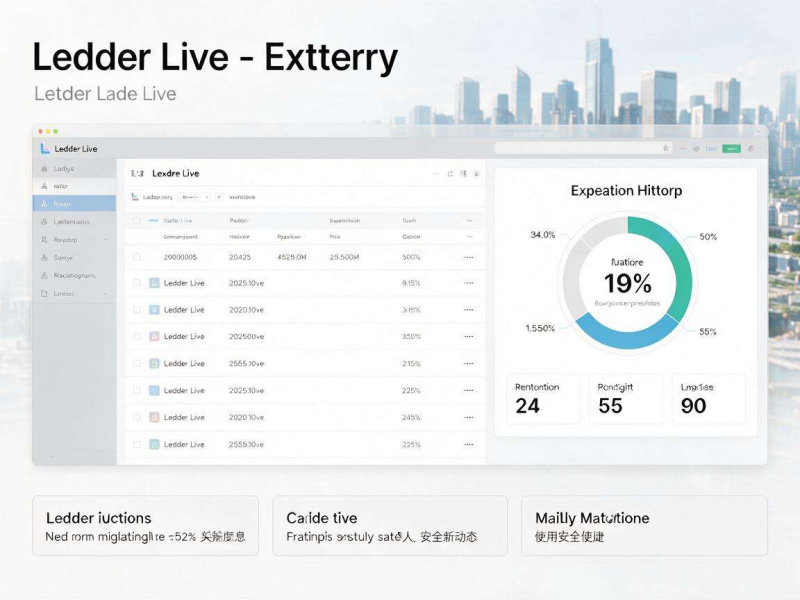
Beyond basic account creation, Ledger Live offers a suite of customization and organization tools designed to make managing dozens of accounts intuitive and low-friction. One of the most widely used features is custom account naming and labeling, which allows users to assign descriptive names to each account—such as “Emergency Savings BTC,” “DAO Voting ETH,” or “NFT Collection Solana”—instead of relying on long, unmemorable alphanumeric addresses. Users can also sort accounts by asset type, current balance, or usage frequency, or pin frequently accessed accounts to the top of the home dashboard for quick access without scrolling through long lists. For users with large numbers of rarely used accounts, or accounts holding long-term cold storage assets that they don’t need to check regularly, the “Hide account” feature lets them remove those accounts from the main view without deleting them or losing access to funds, reducing visual clutter and lowering the risk of accidental transactions to or from inactive accounts. Ledger Live also offers a unified portfolio overview that aggregates balances across all accounts and all supported blockchains, giving users a real-time snapshot of their total net worth in their preferred fiat currency, while still allowing them to drill down into individual account balances, transaction histories, and asset allocations with a single click. For power users who manage assets across multiple Ledger devices—for example, a primary device for daily use and a backup device stored in a secure off-site location—Ledger Live can sync account configurations across devices via optional end-to-end encrypted cloud sync, ensuring that their account organization stays consistent no matter which device they’re using.
Another key use case for Ledger Live’s multi-account system is secure dApp integration via WalletConnect and Ledger’s built-in dApp browser. When connecting to a dApp—whether it’s a decentralized exchange, NFT marketplace, or DAO governance platform—users can select exactly which account they want to use for the connection, rather than defaulting to their main or first created account. This lets users keep their high-value savings accounts completely disconnected from all third-party dApps, only connecting lower-risk, dedicated interaction accounts that hold limited funds allocated for those specific activities. Ledger Live also displays clear, transparent prompts about which account is being connected and what permissions the dApp is requesting, with all transaction approvals requiring physical confirmation on the Ledger hardware device, adding an extra layer of security even for accounts used for high-risk activities. For users who participate in multiple DAOs or hold assets across different DeFi protocols, this means they can assign specific accounts to specific ecosystems to avoid permission creep—for example, using one account for Ethereum-based DeFi protocols, another for Solana NFTs, and a third for Polygon-based gaming, ensuring that a vulnerability in one protocol can’t spread to assets in other ecosystems.
To get the most out of Ledger Live’s multi-account features while maintaining maximum security, users should follow a set of core best practices. First, it’s critical to clearly define use cases for each account and avoid mixing funds between accounts unnecessarily, as frequent transfers can undermine both privacy and risk isolation by linking accounts on-chain. If users need to move funds between accounts, they should do so sparingly and consider using mixing tools or centralized exchanges with withdrawal address whitelisting to break the on-chain link if privacy is a top priority. Second, users should avoid exporting private keys for individual accounts unless absolutely necessary, as exported keys are no longer protected by the Ledger hardware wallet’s secure element and can be stolen by malware or phishing attacks. Since all accounts are derived from the master seed phrase, backing up the seed phrase once is sufficient to restore all accounts in the event of a lost or damaged device, eliminating the need for separate private key backups. Third, users should regularly review their account list to remove or hide accounts that are no longer in use, and audit dApp connections for each account periodically to revoke permissions for protocols they no longer interact with, reducing the overall attack surface. It’s also important to note that while multi-account setup provides strong risk isolation between accounts, all accounts are still tied to the same master seed phrase, so the seed phrase remains the single most critical piece of information to protect—users should store it offline in multiple secure physical locations, never share it with anyone, and never enter it into any digital device or online service.
As the cryptocurrency ecosystem continues to evolve, with new use cases like tokenized real-world assets, on-chain identity, and decentralized social media gaining mainstream traction, the need for organized, secure multi-account management will only grow. Ledger Live’s ongoing updates to its multi-account tools—including recent additions like account grouping for cross-chain portfolios with the same purpose, custom transaction tagging for simplified tax reporting, and integrated portfolio tracking for NFTs and DeFi positions across all linked accounts—reflect the platform’s commitment to meeting the changing needs of self-custody users. For both new users just starting to build their crypto portfolios and experienced holders managing dozens of accounts across multiple blockchains, Ledger Live’s multi-account system strikes a rare balance between security, flexibility, and ease of use, empowering users to take full control of their digital assets without sacrificing organization or peace of mind.